Life Is Poker, Not Chess
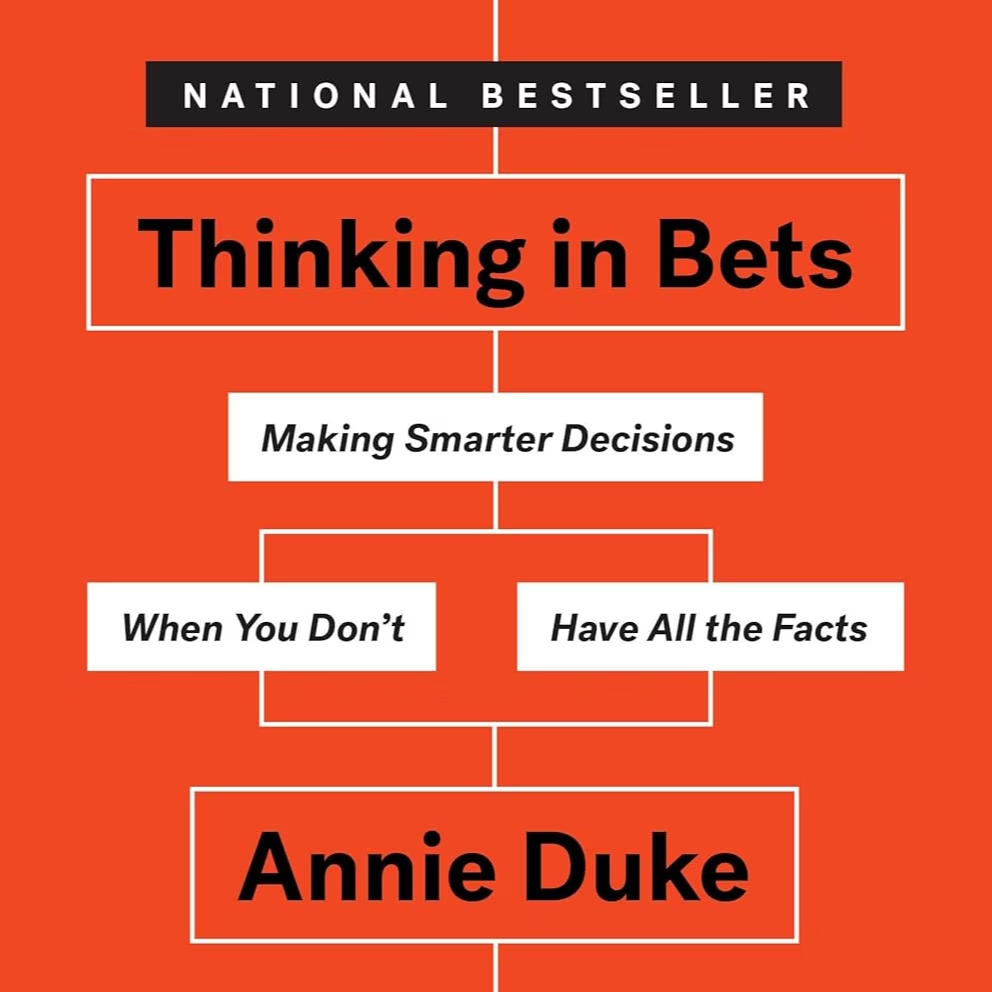
This essay brings together the main lessons I took from the book"Thinking in Bets". I have grouped them into three themes: probability, luck versus skill, and how to make better bets. (Book: Annie Duke.. (2018). Thinking In Bets.)
Over the past year, I have become heavily dependent on AI for everything, small and big. AI has its quirks. Every new model release requires me to understand those quirks all over again.
I first read Annie Duke’s Thinking in Bets in 2020. I enjoyed the book and picked up a few lessons, but forgot most of them. Two weeks ago, after Claude made far too many errors in my code, I recalled a few concepts I read in the book .
I realised that if I have to work with a highly capable probabilistic machine every day, I need to improve my understanding of probabilistic thinking. Last week, I picked up the book again.
Since finishing Mortimer Adler’s How to Read a Book, I have been trying to invest more time to truly understand what I read. I have also been reviewing the highlights and notes from books I enjoyed over the years.
My goal is to write a standalone essay for every book I read, so that I can recall the ideas much faster.
My motive to publish these essays is a bit selfish. Publishing encourages me to critically review my essay. I spent the last 3-4 days editing my essay on ‘Thinking in Bets'. I plan to publish an essay once every two weeks.
Growing up, I always admired chess grand masters for their intelligence. Chess is a game with well defined rules and access to complete information. I adopted a similar mentality: gather sufficient info and reason logically to arrive at the right answer.
Once the outcome of a decision was clear, I judged the decision as good or bad. A positive outcome indicated I made the right choice. A negative result indicated an error on my part. I rarely accounted for luck.
Chess allows you to analyse every move as good or bad. You can learn from our mistakes, and build better mental representations. With deliberate practice, you can improve your game.
A poker game provides us with no such clarity. You cannot see your opponent’s card before placing a bet. Even if you win or lose a hand, you are not clear if your choice was good or bad.
Anne’s central thesis in her book is simple: Life is a game of poker, not chess. You make decisions with limited information. Luck plays a role in every decision’s outcome.
I read Annie’s book to answer a simple question:
How can I make better decisions?
Annie recommends the following:
- Treat every decision as a bet.
- Assign probabilities to our beliefs.
- Focus on the process.
- Be open to disagreements
I classified the ideas presented in the book into three broad themes: probability, luck versus skill, and how to make better bets.
Terms
Throughout the book, Annie uses certain terms to help us understand our mistakes.
Beliefs: Views formed by us based on our experiences, what read or heard from others
Narrative: The story we tell about ourselves. Once formed, we rarely update it with new information
Resulting: Judging the quality of our decisions on its outcome.
Hindsight Bias: ‘I should have seen this happening’ feeling within us
Motivated Reasoning: Limiting ourselves only to facts or analysis that complement our narrative
Black-and-White Thinking: All or nothing. Either it's good or bad. No other option exists in between.
Confirmatory Thought: Defending our beliefs or narrative
Fielding: Analysing the role of luck and skill in a decision’s outcome. We field poorly
“Wanna Bet?”
Annie argues that resulting is our most common decision-making mistake.
An outcome is dependent on how you choose and luck. Even well-thought-out decisions fail, and random ones succeed. You can never exclude luck from the equation.
Resulting makes us treat outcomes as final verdict, not as evidence for further analysis.
You can never say with certainty that our decision was right or wrong. You need to look back when the decision was made to understand better. New information may come into light, and hindsight bias does the rest.
You form certain beliefs on what happened, and why it happened. Over time, multiple such beliefs transform into a narrative about the world, and ourselves. You start ignoring uncertainty behind every such belief.
We then form beliefs from that story. As time passes, those beliefs harden into a narrative about the world and about who we are.
The beliefs start defining us. If someone questions your belief, it feels personal. You start defending them. No wonder, I feel offended when questioned on my political beliefs.
Motivated reasoning lets me cherry-pick facts that fit my political views, while ignoring everything else. I assume I am being rational by presenting facts, but I am just building a stronger defence for my beliefs.
Annie argues that intelligence rarely protects us from motivated reasoning. She writes that intelligence helps a person to review evidence, and search for truth. It also aids you in building a better narrative. You are now defending your beliefs with stronger conviction.
I found this argument a bit hard to accept on face value. Annie asserts that intelligent people tend to be on the wrong side more than others.
Intelligence improves our ability to reason better. How we choose this ability is the key question to ask ourselves. We can either use it to test our beliefs or validate them
Annie’s proposition reminded me of the Greek poet Archilochus. He wrote that a fox knows many things, but a hedgehog knows one big thing. Isaiah Berlin expanded the quote into an essay on how to distinguish between two kinds of thinkers.
Some review multiple ideas before developing their beliefs. Others prefer to bucket their beliefs around one central idea.
When you are clueless, we adopt a fox mentality. Once a certain belief is formed, you slowly morph into a hedgehog. You build one grand theory, and try to fit every new fact within it.
Charlie Munger described a similar habit as the man-with-a-hammer syndrome:
‘To a man with a hammer, every problem tends to look like a nail.’
The problem is not with intelligence. The problem is using one or two ideas to explain everything.
Annie’s recommendation: treat every important belief into a bet. Ask yourself whether you are willing to place real money behind it. The question ‘Wanna Bet’, changes the way we look at our beliefs.
A belief can exist in our head free of cost. Once you evaluate if you can place money behind a belief, we look at it closely.
- Where did the belief come from?
- How good is the source?
- What am I missing?
- What would make me change my mind?
Annie recommends expressing your confidence as a number. Instead of saying, “I am sure.”, say, “I have seventy percent confidence.”
The number does nothing to our belief, it just makes you express the uncertainty behind our belief. You can move from 70% confidence to 50% if new facts emerge. It is far easier than moving from “I am sure” to “I am not so sure”.
The scientific method offers us a useful analogy. Scientists observe the natural world, ask questions, test ideas, and state their conclusions.
Peers can review to either accept or criticise their findings. If evidence emerges that contradicts their findings, they are open to modifying their theories.
Scientists are also human. A few may get attached to their theories, and resist criticism. However, the scientific method permits others to question their beliefs openly.
I have never questioned the credibility of a scientist even when new evidence disproved their theories. Most of them acknowledge it openly. I trust such scientists even more.
If you can rate your confidence, accept uncertainty, and explain why your view has changed, you can think clearly.
The aim is not to doubt everything. It is to stop claiming more certainty than your belief deserves
Luck Versus Skill
Once an outcome is known, we need to answer a far tougher question: Was the result due to my skill, or was I just lucky. Annie calls this fielding. She argues that most of us field poorly.
We are the heroes of our own life stories. We believe that success is due to our skills and losses are due to bad luck. This protects our ego. The protection prevents us from learning our wins and losses.
You may double down on a poor choice because it worked once. You might abandon a sound process because of a single failure.
A regular coin has an equal chance of landing heads or tails. Toss it ten times. It is highly likely to get more than five heads or tails. Even one thousand such tosses doesn’t guarantee exactly five hundred heads and five hundred tails.
Suppose you earn ₹100 for every head and lose ₹100 for every tail. The odds are even. Your calculations say that you will neither win or lose any money. However, after a small number of tosses, you may end up richer or poorer.
The same game plays out in business and life. A good process can fail due to bad luck. A weak process can benefit from one lucky run.
The expectation of a large payoff can make our earlier losses feel irrelevant. We play such games even when our calculations say otherwise. The payoff resets our expectations and encourages us to try again.
This is one reason you sometimes repeat certain actions even when the process is doubtful. Luck can often reward wrong behaviour.
Two other biases make it harder to learn from outcomes: hindsight bias and black-and-white thinking.
Once an outcome is known, the result feels inevitable. You create a story explaining why it happened and tell ourselves that it was obvious.
The lingering doubts that existed before the decision disappears from our memory.
We also prefer to rate every result as either a clean win or a clear loss. However, most outcomes are a muddy mixture of both.
A failed business idea may reveal a useful customer segment. A profitable contract may consume so much working capital that it places our entire business at risk. A successful hire does not prove that our hiring process is sound.
Each result contains several lessons. Black-and-white thinking compresses them into a key takeaway. We get a simple answer. We prefer certainty over uncertainty, and in control of our decision’s possible outcomes.
Hindsight bias and black-and-white thinking offer us a comforting story. They do not provide us with an accurate one.
Annie argues that the one way out is honest fielding. Ask yourselves how much was due to our skill, how much was due to the situation, and how much was due to luck.
Situation matters a lot. The same action is rational under certain and careless under another. No decision can be judged without taking into account the information, constraints, alternatives, and risks.
You can never separate skill and luck with complete accuracy. However, never avoid asking the question: Was the result due to my skill, or was I just lucky
A rough but honest answer is better than a nice story that protects the ego. You can learn only when you are honest with yourself on why things happened the way they did.
Improving Our Decisions
Recognising our biases does not eliminate them.Annie argues that you cannot correct your thinking on our own.
We are good at spotting errors in other people’s reasoning but poor at finding the same errors in ours.
She suggests forming a small group that debates decisions. Reward accuracy over agreement. The purpose is not consensus. It is to improve the quality of our beliefs.
During a case discussion in my Supply Chain Management course at ISB, the professor explained how average conceals the multitude of potential outcomes a system has to manage.
I started investing in index funds based on an expected average return of 12-13%. My actual returns in the past ten years fluctuated between -18% and 24%. It is clear that relying only on the average isn't enough; you need to account for the fluctuations and evaluate whether you can accept it.
I see a similar lesson in Annie’s argument. Once you consider several possible outcomes, you are better prepared for a future where things don't go the way you initially assumed.
Annie recommends building your own decision Group. Such groups should adopt the CUDOS framework, which was developed by Robert Merton while studying how science should work.
CUDOS stands for Communalism, Universalism, Disinterestedness, and Organised Scepticism.
- Communalism means that relevant information should be available to the group.
- Universalism means that the same standard should apply to every claim, regardless of who made it.
- Disinterestedness means remaining alert to interests that may affect judgment.
- Organised scepticism means that questioning and disagreement should be expected.
A decision group should judge an idea on its merit, not on the status of the person who suggested it.
The idea sounds great on paper but difficult to adopt. Everyone, including me, prefers spending time with people who share similar beliefs. I often avoid people who disagree with me.
A decision group works only when every member can ask difficult questions. They must be free to test the logic, examine the facts, study the situation, and consider other possibilities.
Over the past year, I used AI to debate my ideas. I can ask it to act as a devil’s advocate and criticise my reasoning. Most of the time, AI often softens the criticism. In the end, AI has been trained to be a helpful assistant.
I am currently testing a different approach. I tell the AI that the idea came from a friend and that I need to give him critical feedback. AI response appears more critical than before. It is too early to conclude that my method works, but it is slightly better than my earlier approach.
Annie warns against running these conversations only inside our own heads. We already know which answer we want. Our imaginary critic, including an AI critic, may not be strong enough. Asking AI or ourselves to think like Steve Jobs is not the same as actually asking Steve Jobs.
It is often better to ask someone for feedback. State upfront that her or she can disagree with you.
When reviewing a decision, Annie suggests hiding the outcome from the group. Share only the facts, assumptions, situation, alternatives, and decision-making process. Tell the story only up to the point where the decision was made.
If the group already knows the outcome, hindsight bias will affect the review. Members will work backwards and find reasons why the result was predictable.
The final chapter uses time to create distance from our present emotion. One method is the 10-10-10 rule introduced by Suzy Welch.
Ask what the consequences of a choice will be in ten minutes, ten months, and ten years.
Warren Buffett made a related point in his 1996 shareholder letter. He wrote that investors unwilling to own a stock for ten years should not consider owning it for ten minutes.
Annie also recommends looking backwards.
- How would I feel today if I had made this decision ten minutes ago?
- What if I had made it ten months or ten years ago?
- Would I accept the reasoning, or would I call it careless?
Annie acknowledges that no framework or process or tool will make us perfectly rational. Every idea in the book is meant to help us think more clearly.
You can never remove emotion or past experience from our decisions. Nor should you pretend that emotions provide no useful information. Fear may point towards a risk. Excitement may point towards an opportunity.
The problem begins when the emotion of the moment overrides our entire decision-making process.
Annie recommends debating multiple possible outcomes before acting. She discusses three methods that can help: backcasting, pre-commitment, and the premortem.
Backcasting begins with the desired result. Imagine that the goal has already been achieved, then work backwards.
- What needed to happen immediately before success?
- What needed to happen before that?
Ask the same questions at every important stage. Backcasing allows you to unearth certain conditions required for a plan to succeed. It also helps you notice when one of those conditions no longer holds.
Pre-commitment means deciding some rules before pressure arrives.
An investor may decide when to sell before buying. A business may set its maximum credit period before entering a negotiation.
Pre-Commitment rules are not permanent in nature. When new facts emerge, you can update them. These rules act as a natural speak-breaker. Ask yourselves if the facts have changed or whether our emotions are at play.
A premortem assumes that the project or plan has failed. Now you prepare a report explaining the failure. List down all plausible reasons for failure.
Treating failure as given makes it easier to share concerns. During planning phases, others ignore sharing their concerns to avoid being labelled a skeptic or against the team. The exercise is meant to bring forth all hidden risks into the open before moving ahead.
Backcasting begins with success. A premortem begins with failure. Pre-commitment protects the decision from the person you may become under pressure.
None of these methods predicts the future. They just force you to think in more vivid details about the future
Where This Leaves Me
Reading the book made me realise that the book is not me offering tools that guarantee me more wins. Annie is explaining how poker helped her to think more clearly.
The book made it clear to me that a good decision can fail, and a poor one can succeed. The aim is to improve the process, not guarantee the outcome.
‘Thinking in Bets’ is a primer for anyone interested in developing a probabilistic thinking mindset.
Now, not every decision needs this detailed analysis. If I apply the entire process for every decision, I would be just wasting my time. It could even become another way to avoid acting.
The book’s approach matters when the stakes are high, when the choice is difficult to reverse, or when one outcome can determine what happens next.
I clearly see the value of recording the reasoning behind major decisions. A written record gives me something more reliable than memory when I review it later.
I currently don’t maintain any decision journal. I planned to build one when I first read the book but kept delaying. Reading the book again made it clear that I can’t keep delaying building one.
The tools in the book assume that past failures don't impact my present survival. A decision can have favourable odds and still be unacceptable. It can offer a good expected outcome while exposing me to ruin.
The average result does not matter if one bad outcome removes my ability to continue.
Before asking whether something is a good bet, I need to ask whether I can survive being wrong.
- How much can I afford to lose?
- Can I reverse the decision?
- What happens if the least favourable plausible outcome occurs?
Not every decision is reversible.
Poker players can make another bet only while they still have chips. A business can make another decision only while it still has cash, people, trust, and time.
My first rule is simple: Never make a bet you cannot survive losing.
Appendix A: Question Bank
- Which past decision am I calling good or bad mainly because of its outcome?
- What alternative futures did I reject, and what is the opportunity cost for such rejections?
- What probability would I attach to my current belief if I had to make the estimate public?
- What evidence would cause me to change that estimate by at least twenty percentage points?
- Which part of a recent outcome came from process, execution, other people, hidden information, and luck?
- What explanation of this outcome best protects my self-image, and what does that incentive cause me to ignore?
- Who could review this decision without knowing my position or the eventual outcome?
- Does my decision group contain different evidence and assumptions, or merely different personalities?
- What must be true for the desired future to occur, and which required event has the lowest probability?
- If the plan failed completely, what cause would appear obvious in hindsight, and what can be done about it now?
Appendix B: Decision Rules
- Never make a bet you cannot survive losing.
- Treat every important belief as a bet.
- State confidence as a probability.
- Decide in advance what would change your mind.
- Judge the decision separately from its result.
- Separate skill, circumstances, and luck.
- Record the reasoning before the outcome is known.
- Ask for disagreement before seeking approval.
- Examine both success and failure before acting.
- Make rules before emotion arrives.