Personal Essays
-
The Jobs I May Never Create
An IISc professor paused his lecture to ask why his students were still attending his lecture . Claude or ChatGPT can teach them patiently. He goes on to question the value of university education and the job prospects for new graduates. While how AI will affect the career opportunities for highly skilled graduates is not clear, I can see AI’s impact on small businesses such as mine. I currently run a manpower services business. My business deploys blue-collar workers across India. While AI can’t replace my core service, it has changed how I view hiring within my own company. Until 2024, if my office workload increased or an employee quit, I would hire someone. Hiring was the quickest and cheapest way to manage the work. While a lot of my operations depend on SaaS tools, I couldn’t afford an expensive ERP system. Excel and a well trained employee were good enough for me. My dad started this business in 2014. He managed his operations with Excel, Tally and six employees. I took over the business in 2019 after my dad’s sudden demise. The first covid lock-down hit my business hard. Our revenue fell by 60% within 15 days. My entire business data resided in my locked office. Excluding my field operations, everything else was held up for around 20 days. Luckily 15 days after the lock-down, our business was classified as essential. I could open my office for a few hours to get things moving again. As the situation improved, I moved the invoicing from excel and tally to Zoho Books. Employee management and payroll also transitioned from excel to a custom payroll software. Now, my employees could work remotely when required. In the same period, I spent 4-5 months reviewing and documenting my entire invoicing and payroll process. This helped me more than I assumed. Once the lock-down ended, my business picked up. We grew by 40% (prior to lock-down). The payroll software drastically reduced our calculation errors. My team could complete invoicing on or before 7th. I had no need to hire another person to handle the additional work. In Dec 2020, my accountant suffered a stroke. He could no longer work, so he resigned. I knew hiring another senior accountant would take time. However, the new software system allowed me and my team to manage our work without any hassles. The entire migration helped me understand my business in depth. So, I took over cash-flow and cost management responsibilities. Zoho Books generates a financial report at the click of a button. I was no longer dependent on anyone else for any financial reports. I never found a need to hire another senior accountant for my business. I hired a junior accountant, who was good enough for my needs. Now AI is making this process much faster and easier. Whenever my team’s workload increases, I spend an hour with them to understand the changes. I flesh out what can be automated. Then I use Claude Code or Codex to build a prototype, get feedback from my team and get it operational within 2-3 days. In the past few months, I automated our compliance audit reports, site audit reports, and customer service requests. I avoid automating one-off customer requests and reports. My team fetches the raw data from Zoho Books or Payroll software. They upload the file to a web based tool and the report is generated in a jiffy. After developing a few tools, I felt confident enough to build my own ERP system (O9X), which I started in Nov’25. I am trying to standardise my operations, payroll and compliance reports. I don’t plan to reduce my employee count. I want everything my team does to be consistent across every customer. In the past three months, I migrated my field operations to O9X. I get regular feedback on what is working and what is failing. I developed additional features based on my team’s suggestions. Building with AI is not easy. Prior to this, I built my company website in Nextjs (used a template). I started using AI to develop small tools. Before starting anything new, I need to think hard on what I need. More than half the things I build fail. Most of my time is spent fixing issues or improving my initial ideas. An agency or experienced developer might avoid most of my mistakes. However, coordination consumes a lot of my time and energy. Everyone has their own priorities. When I ask my payroll vendor for a small change, they take around 2-3 days to implement it. I can make such changes within 2-3 hours using AI. AI’s rapid improvement allows me to develop my own tools as my business grows. I no longer find the need to purchase costly or complicated software. Now, this is where the employment question becomes interesting. Currently, three people oversee accounting, payroll and invoicing across my entire business. My count of field staff has gone up in the past three years, but my office employee count is the same. I hypothesise that I might hire just one more person in an office role even if my business doubles. I will keep automating more of my office work with the help of AI, so my office can run with a lower employee count. I could be wrong. I may end up hiring more people if my business doubles. I am not in the business of predicting the future. For now, I am planning on the assumption that I can manage with fewer office employees. AI is reducing cost for small businesses such as mine. The lower cost structure might even encourage more people to start their own business. The employment generated by such new business may exceed the jobs that were never created due to AI. How will this play out ? I don’t know. In India, small business such as mine (MSME) employ a large number of people. MSME employees are a mix of factory workers, field personnel and office administration. How much AI reduces demand for new employees within MSME is hard to estimate. Now, not a lot of small businesses have adopted AI with the same enthusiasm as me. When or how AI will be adopted by other small business owners is hard to predict. I review every new customer request by answering three questions: Is it a one-off need or a recurring requirement? If I spend hours automating one-off requests, I may end up wasting my own time. I need to be judicious about where I invest my time. If recurring, can it be automated? If not, can I automate some other work for my team? Hiring another office employee is my last resort. I am not laying off anyone, but neither have I found the need to create a new role as my business and customer demands grow.
-
The Agency Cost: Why You Can't Hire Your Way Out of Ignorance
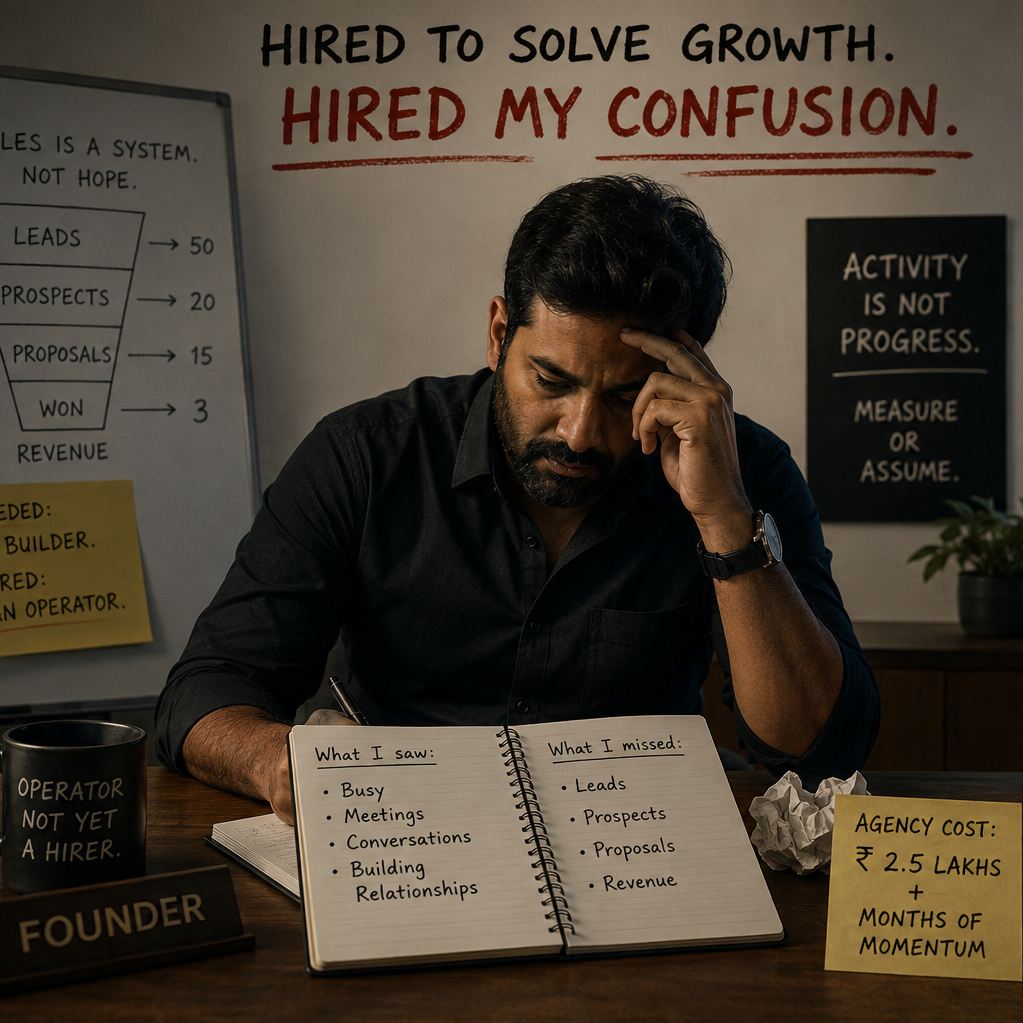
By Sept 2021, my business stabilised after 18 months of Covid disruption. I could focus towards growth instead of survival. I spent most of my career in operations, with limited understanding about sales. I knew words such as leads, prospects, pipeline, follow-up and relationship management. However, I did not know what those words meant when applied to my own business. So I decided to hire a "Sales Manager". Six months and ₹ 2.5 Lakhs poorer, I learnt a simple lesson: I cannot hire well for a function when I cannot separate activity from progress. I was not hiring for a "Sales Manager". I was searching for clarity I did not have. After meeting a few candidates, my Ops manager recommended someone with 12+ years of experience in my industry. During his interview, he shared multiple anecdotes and success stories from his prior roles. He rarely mentioned how he did it or what support he needed from me to succeed. I had my doubts but my limited knowledge and my operations manager's confidence made me ignore them. I made him an offer. He joined a week later. Most articles and podcasts on sales repeat the same advice: Sales takes time and effort. Trusting that advice I told him: I don't expect results for the first two months. I expect business to start flowing in 45 to 60 days from now. Take your time to settle in and keep me posted on a weekly basis. What I actually said was: I don't know how to measure sales, so I will pay you to exist and hope revenue appears. For the next 90 days, he updated me on his ' building relationships' , ' reaching out to my network', and ' having conversations ' activities. He appeared busy but apart from a single proposal, nothing else happened. Sales, like any other business function, has its own set of metrics. I should have tracked leads generated, qualifying leads to prospects, and proposals sent. I never correlated his update work to any metric. So, I could not verify if he was doing the work or not. Here is what I had missed: even if he did work hard, he would have failed. He knew how to work inside an established sales system. He had not shown that he could build one from scratch I asked him to resign and he left quietly. A week later, I ran the numbers: I paid him ₹ 2.5 Lakhs as salary and generated zero revenue. I could earn the money back, but never recover the time. I had wasted the post-lockdown momentum in the market. I expected him to build a sales machine for me. I needed a builder, but I hired an operator (someone used to working inside a proven system). I could not tell the difference between "the market is tough" and "the approach is wrong". It is easy to blame him. The larger mistake was mine. I never tested whether he could build. In " Rework ", the Basecamp founders explain why they do the job before hiring for it. They valued clarity on the work before hiring anyone. It made sense when I read it. I ignored it when it mattered. I spent the next few weeks actually doing the job I was scared to do. I reviewed our existing leads, set up meetings and shared our service proposal. My team qualified 50 leads, met 20 prospects, sent 15 proposals, and won 3 contracts I realised I had already been doing sales work. I had just never called it "sales”. Once our leads dried up, the real bottleneck was visible: we had no process to generate new ones. Rather than hiring for a "Sales Manager", I needed someone who could generate new leads. While I am yet to hire a "Sales Manager", the lesson stayed with me: Try doing the job for two to three weeks before hiring. For roles I cannot do, I research to define progress metric before hiring. Economists call this agency cost : paying for work that you can't inspect. My failure to understand costed me ₹ 2.5 Lakhs and months of momentum. Now, before I hire to solve a problem, I spend two to three weeks doing the work. Once I am able to write three specific metrics that explains the work's progress, only then I decide who needs to be hired. If I cannot define at even three progress signals, I am not ready to hire. I am only outsourcing my confusion to someone else